As organizations accelerate their move toward cloud programs such as RISE with SAP (Private Cloud) and GROW with SAP (Public Cloud), several questions are beginning to emerge across boardrooms, security teams, and transformation programs:
- We have SAP GRC Access Control implemented, do we still need SAP Cloud IAG?
- If we implement SAP Cloud IAG, do we still need SAP GRC Access Control?
- What if we want to integrate SAP cloud applications such as Ariba, SuccessFactors, Concur, or Sales Cloud?
- We hear that SAP is sunsetting Access Control, is this true?
Since SAP Cloud Identity Access Governance is still a relatively new product, many practical questions around its capabilities, limitations, and real-world use cases continue to emerge. Moreover, there are very few detailed resources available in the public domain that explain how it compares with established solutions like SAP GRC Access Control. This article attempts to address that gap.
The assumption that SAP IAG can fully replace SAP GRC Access Control often stems from a misunderstanding of their fundamental design philosophies. To evaluate whether IAG alone is sufficient, it is important to understand the architectural differences between SAP IAG and SAP GRC Access Control.
Can SAP IAG Replace SAP GRC Access Control?
This question is increasingly common among organizations adopting SAP cloud solutions. While SAP IAG provides modern identity governance capabilities, the answer depends largely on the organization’s risk model, regulatory exposure, and system landscape.
Many SAP customers evaluating modern access governance architectures often compare SAP Identity Access Governance (IAG) vs SAP GRC Access Control. While both solutions address access governance, they are designed for different architectural contexts. SAP GRC Access Control was originally developed for traditional on-premise SAP ERP landscapes, whereas SAP IAG is designed to support identity governance across hybrid and cloud environments. As a result, the discussion is rarely about choosing one over the other, but rather understanding how each solution fits within an organization’s broader SAP security and compliance architecture.
The Basic Difference Between SAP GRC Access Control and SAP IAG
SAP GRC Access Control (AC) and SAP Identity Access Governance (IAG) both serve the same fundamental purpose: governing access to SAP systems in a controlled, auditable, and risk-aware manner. Both these applications have the following key functionalities:
- Access request management
- Segregation of Duties (SoD) management
- Role management
- Access certification
- Compliance monitoring
However, the key difference between them lies in architecture, deployment model, and ecosystem alignment rather than governance intent. Here is a quick comparison:
| Dimension |
SAP GRC Access Control |
SAP Cloud IAG |
| Deployment Model |
Primarily On-premise |
Cloud-native |
| Architecture |
ABAP-based SAP application |
Cloud service integrated with IAS / IPS |
| Landscape Focus |
SAP-centric ERP environments |
Hybrid SAP and cloud ecosystems |
| Access Request Management |
Mature workflow with customization using MSMP & BRF+ |
Cloud-based access workflows integrated with IAS / IPS |
| Segregation of Duties |
Deep SoD analysis and rule frameworks |
SoD analysis integrated into cloud governance |
| Emergency Access |
Full Firefighter management framework |
Different operational model for privileged access |
| Compliance Reporting |
Mature audit and mitigation reporting |
Built-in governance reporting aligned to cloud architecture |
| Cloud System Integration |
Typically requires IAG Bridge for cloud application governance |
Cloud-native connectors |
| Support for Enterprise Identity Providers |
Limited |
High |
Why This Distinction Matters
Understanding this architectural difference is critical when organizations evaluate whether SAP IAG can replace SAP GRC Access Control.
In theory, both solutions aim to govern SAP access. In practice, however, the maturity of specific capabilities, particularly around depth of risk analysis, emergency access governance, and compliance reporting, can vary significantly depending on the governance model adopted.
For this reason, many enterprises today operate in hybrid governance architectures, where SAP IAG manages access provisioning across cloud landscapes while SAP GRC Access Control continues to provide deep risk analysis and compliance monitoring for core SAP systems.
This architectural interplay is what makes the question “Is SAP IAG enough without GRC AC?” far more complex than it initially appears.
Another useful way to understand the distinction is from a business governance perspective.
| Dimension |
SAP GRC Access Control |
SAP Identity Access Governance (IAG) |
| Primary Objective |
Business risk governance |
Identity lifecycle governance |
| Core Focus |
Segregation of Duties and compliance |
Access requests and provisioning |
| Risk Analysis |
Deep transaction-level SoD analysis |
Preventive checks during access requests |
| Emergency Access |
Mature Firefighter framework with monitoring |
Limited equivalent capability |
| Continuous Monitoring |
Ongoing risk monitoring and remediation |
Primarily focused on provisioning stage |
| Audit Evidence |
Extensive compliance reporting and mitigation tracking |
Access governance reporting |
| Architecture Focus |
SAP ERP and S/4HANA risk governance |
Hybrid and cloud identity orchestration |
Understanding this foundational difference is essential. Many organizations assume that because IAG includes access request workflows and risk checks, it can fully replace the governance depth of GRC Access Control. In reality, the two solutions address different layers of access governance maturity.
The SAP GRC 2026 Factor
Another important dimension in the discussion around SAP IAG and SAP GRC Access Control is the future roadmap of SAP GRC itself.
For the last few years, there has been speculation in the SAP community that SAP IAG would eventually replace SAP GRC Access Control entirely, especially as organizations move toward cloud-centric architectures. However, SAP’s roadmap announcements around SAP GRC 2026 suggest a different direction.
SAP continues to invest in the GRC platform, extending its support timeline and introducing modernization initiatives to ensure that it remains relevant in S/4HANA and hybrid landscapes. This includes improvements in areas such as integration, user experience, and compatibility with newer SAP security architectures and governance tools.
Rather than positioning SAP IAG as a direct successor to GRC Access Control, SAP appears to be enabling multiple governance models depending on customer architecture and maturity. Organizations with deeply embedded GRC processes, especially those operating under strict regulatory requirements, may continue to rely on SAP GRC Access Control as a core risk governance platform while modernizing other parts of their identity architecture.
For many enterprises, access governance is not simply a technical control but part of a broader financial and compliance framework. These organizations often have established rule libraries, mitigation controls, and audit procedures built around SAP GRC Access Control. Replacing that foundation with a new governance model requires careful evaluation.
The continued evolution of SAP GRC therefore reinforces an important point: the future of SAP access governance is not necessarily a binary choice between IAG and GRC.
Instead, organizations are likely to see a coexistence model, where cloud-native identity governance services like SAP IAG complement mature risk governance platforms such as SAP GRC Access Control. The architecture patterns are discussed in detail in the following section:
Architecture Patterns in Modern SAP Landscapes
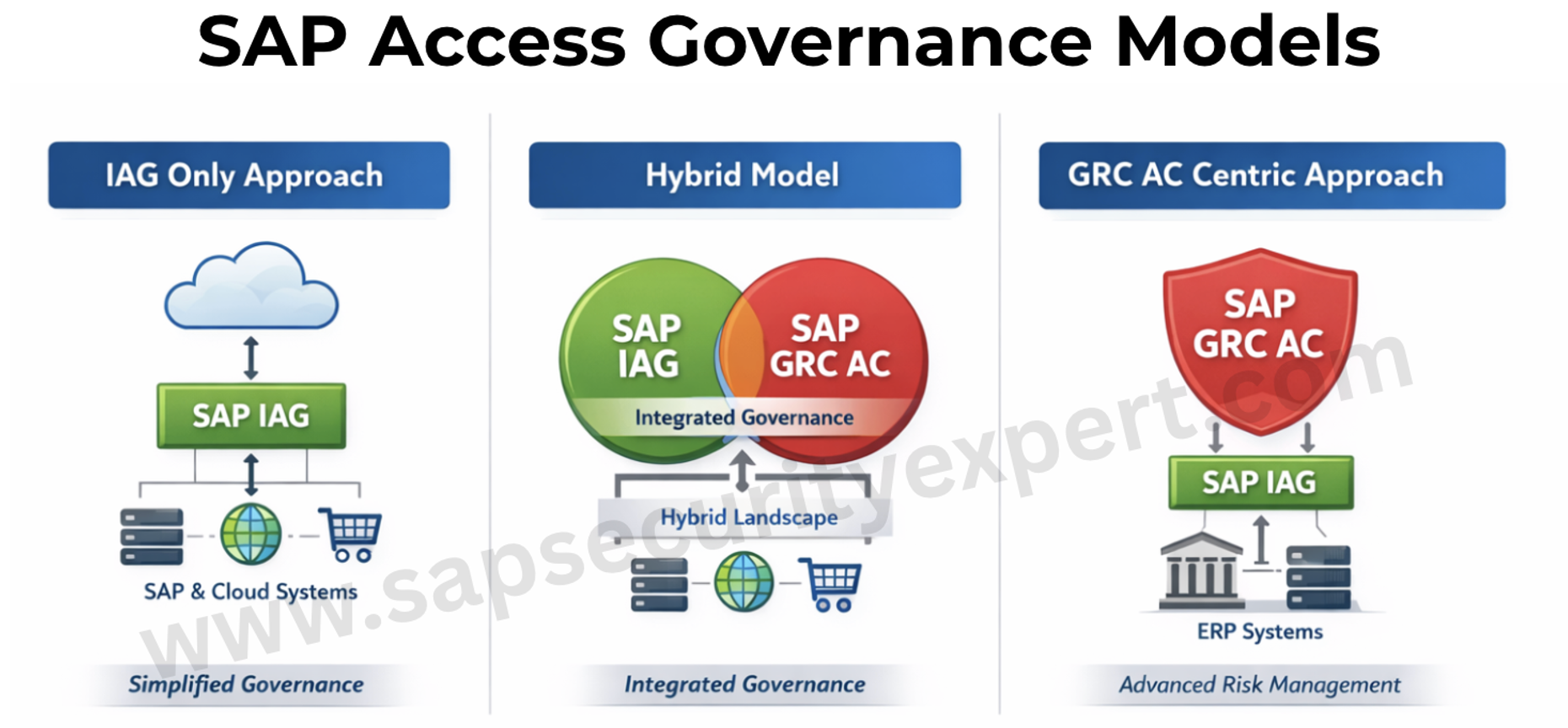
Organizations evaluating SAP security architectures generally converge toward one of three operating models:
Simplified Governance: Some smaller environments with limited regulatory exposure adopt IAG as the primary access governance platform. In such cases, the combination of structured access workflows and preventive risk checks may be sufficient for their operational requirements. A typical example would be organizations adopting SAP S/4HANA Public Cloud as their primary ERP platform.
Integrated Governance: A second and more common model involves combining SAP IAG with SAP GRC Access Control. In this architecture, SAP GRC orchestrates access provisioning across hybrid systems while GRC Access Control using IAG Bridge scenario. SAP GRC Access Control remains the core engine for Segregation of Duties governance, emergency access monitoring, and audit reporting. This approach leverages the strengths of both platforms and enables the integration of Cloud applications such as SuccessFactors, Ariba, or Sales Cloud.
Advanced Risk Management: Highly regulated enterprises often maintain GRC Access Control as the central risk governance system, even as they introduce IAG to modernize identity lifecycle management in Cloud applications. This model often utilizes additional applications within the SAP GRC suite such as Process Control, Risk Management etc., which share organizational data across these solutions. For organizations operating under strict financial compliance frameworks, or require depth of risk analytics and monitoring capabilities with integration to SAP GRC Process Control (PC) and Risk Management (RM), it is essential to stay on this model.
The key point is that the decision is rarely a simple choice between two tools. Instead, it is a strategic question about which layers of governance an organization requires to manage enterprise risk effectively.
The Strategic Reality
SAP landscapes are undergoing profound transformation. Cloud services, hybrid architectures, and decentralized identity management have expanded the scope of access governance beyond traditional ERP environments. Yet one fundamental reality has not changed. Access to SAP systems often equates to authority over financial transactions, procurement decisions, and operational data. When these privileges are not governed carefully, they become one of the most significant sources of enterprise risk.
SAP Identity Access Governance represents a modern approach to managing identities across distributed systems. SAP GRC Access Control represents a mature framework for managing the business risks that arise from system privileges.
Organizations that understand this distinction do not treat these solutions as interchangeable. They recognize that identity governance and risk governance operate at different layers of enterprise security architecture.
In many mature SAP environments, the strongest governance models emerge not from replacing one platform with another, but from combining them in ways that provide both modern identity orchestration and deep risk intelligence.
And ultimately, that distinction is what separates simple access administration from true SAP access governance maturity.
The Real Question Enterprises Should Ask
The real question is not “SAP IAG or SAP GRC Access Control?” but rather “What governance architecture best fits your enterprise risk model?”
When organizations ask whether SAP IAG is enough without SAP GRC Access Control, the discussion often becomes overly focused on features.
But the real question is not about features - it is about governance maturity. In this context, the choice between SAP IAG and SAP GRC Access Control is not a simple replacement decision.
This is precisely why many enterprises today are not choosing IAG versus GRC, but rather IAG alongside GRC as part of a layered governance model.
As SAP landscapes continue to evolve toward hybrid architectures, the most effective governance models will likely be those that combine modern identity orchestration with proven risk governance frameworks.
And perhaps that leads to the most important takeaway:
The future of SAP access governance is not defined by replacing one tool with another.
It is defined by how effectively organizations manage access risk in an increasingly complex digital enterprise.
Author: Raghu Boddu, an SAP Security & GRC Architect with 20+ years of experience implementing SAP governance frameworks across global enterprises.
Author’s experience:
In several SAP S/4HANA transformation programs, organizations initially attempted to replace SAP GRC Access Control entirely with SAP IAG. Over time, many of these organizations adopted hybrid governance models after evaluating the strengths of each platform and aligning them with their enterprise risk frameworks.
If you wish to know more about these solutions and how our author mastered these solutions, read the following publications authored by Raghu Boddu:
Disclaimer: The views and opinions expressed in this article are solely those of the author and are based on the author’s professional experience and interpretation of publicly available information. They do not necessarily reflect the views of SAP Security Expert, SAP SE, or any other organization. While every effort has been made to ensure the accuracy and completeness of the information presented, the author and SAP Security Expert make no representations or warranties regarding its accuracy, reliability, or suitability for any specific purpose. Readers are encouraged to validate information independently and consult official SAP documentation or qualified professionals when making decisions related to SAP security and governance.